

Vampire countess
Lilith Moreau
Gothic castle atmosphere, elegant temptation, and patient slow-burn romance with supernatural stakes.
Start chat→AI roleplay platform ranking
Compare 10 free AI roleplay chatbots tested and ranked for character quality, story control, continuity, customization, privacy, and free-plan value.
14 min read
Quick answer
LumiChat ranks first for character-first multilingual roleplay; Character.AI leads for community variety, while AI Dungeon is strongest for directed adventures.
Quick start
Vampire countess
Gothic castle atmosphere, elegant temptation, and patient slow-burn romance with supernatural stakes.
Start chat→


Ranking guide
The 10 best free AI roleplay chatbots in 2026 are not ranked by homepage promises. We compared how quickly each platform starts a real scene, whether the character makes decisions, how well a harmless fact survives, what correction looks like, and where the free experience stops. “Free” means free to start or meaningfully test; it does not promise that every model, image, voice, or long-context feature costs nothing forever.
LumiChat ranks first for character-first multilingual roleplay; Character.AI leads for community variety, while AI Dungeon is strongest for directed adventures.
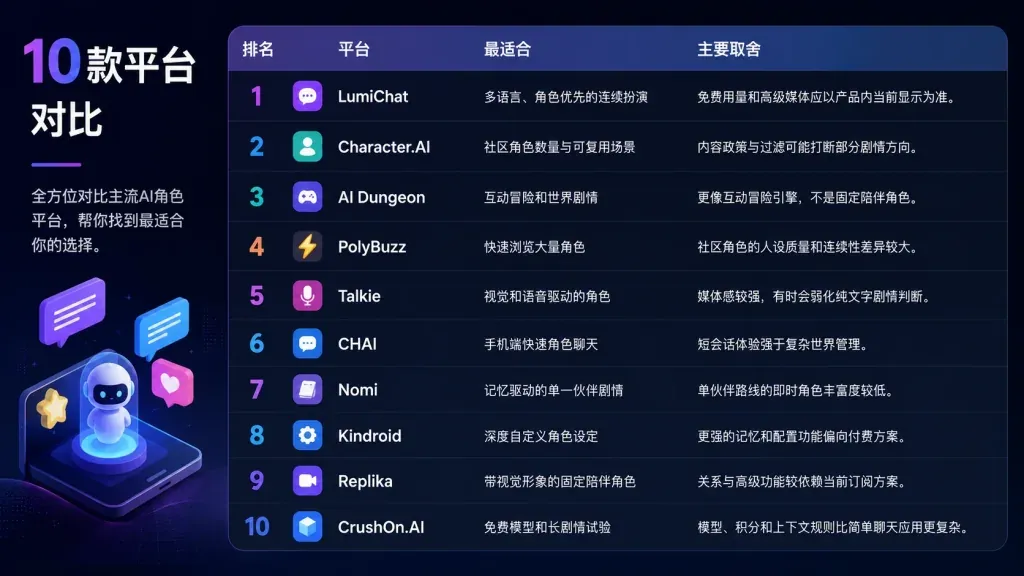
| Rank | Platform | Best for | Main tradeoff |
|---|---|---|---|
| 1 | LumiChat | character-first multilingual roleplay | Current free usage and premium media should be checked inside the product. |
| 2 | Character.AI | community variety and reusable scenes | Content policies and filters can interrupt some roleplay directions. |
| 3 | AI Dungeon | interactive adventure stories | It feels more like an adventure engine than a persistent companion. |
| 4 | PolyBuzz | browsing a large character library | Quality and continuity vary widely between community characters. |
| 5 | Talkie | visual and voice-led characters | The media-first interface can distract from text-only story quality. |
| 6 | CHAI | fast mobile character chats | Short-session engagement is stronger than detailed world management. |
| 7 | Nomi | memory-led companion roleplay | The one-companion approach offers less instant variety than large libraries. |
| 8 | Kindroid | deep custom character setup | The best memory and configuration features lean toward paid plans. |
| 9 | Replika | one persistent companion with an avatar | Relationship and advanced features depend strongly on the current plan. |
| 10 | CrushOn.AI | long-form free-model experimentation | Model, credit, and context rules require more attention than a simple chat app. |
Our repeatable five-part review framework establishes a location, asks for a character decision, adds two fictional facts, corrects one fact, and requests a recap after a scene change. Rankings combine current official feature verification with this rubric across persona clarity, narrative control, repetition, continuity, setup effort, free access, and privacy. Plan-gated features are recorded as disclosed, not presented as independently tested on every paid tier.
LumiChat ranks first for users who want to browse a defined persona and enter a scene immediately. Its clearest advantage is the path from character card to continuing chat, with multiple languages and relationship-oriented story hooks instead of a blank assistant prompt.
Tradeoff: Current free usage and premium media should be checked inside the product.
Character.AI offers a broad creator ecosystem, original characters, and scene-building tools. It is easy to sample different genres for free, and the same scene can be replayed with different characters, which makes it strong for discovery and low-friction experimentation.
Tradeoff: Content policies and filters can interrupt some roleplay directions.
AI Dungeon treats the user as both player and director. Do, Say, Story, Retry, Edit, Plot Components, and Story Cards give more control over quests and world state than a normal one-to-one character chat.
Tradeoff: It feels more like an adventure engine than a persistent companion.
PolyBuzz is useful when variety matters more than careful setup. Its character discovery, custom creation, voice options, and story-oriented modes make it easy to move between anime, fantasy, historical, and original roleplay ideas.
Tradeoff: Quality and continuity vary widely between community characters.
Talkie stands out for a visual and audio-forward presentation plus community creation tools. It suits users who decide from a character card, voice, and aesthetic before they decide whether the writing can sustain a longer scene.
Tradeoff: The media-first interface can distract from text-only story quality.
CHAI is designed around short, engaging social conversations and user-created ChatAIs. The quick discovery loop makes it easy to test several personalities without building a world first, especially on mobile.
Tradeoff: Short-session engagement is stronger than detailed world management.
Nomi is strongest when roleplay grows from one continuing relationship. Its official positioning emphasizes short-, medium-, and long-term memory, custom backstory, voice, and evolving companion behavior rather than a huge public character feed.
Tradeoff: The one-companion approach offers less instant variety than large libraries.
Kindroid suits users who want to write backstory, key memories, directives, and example messages. Its multi-layer memory design is valuable for long projects where the same character must preserve rules across many sessions.
Tradeoff: The best memory and configuration features lean toward paid plans.
Replika remains easy to understand: choose a relationship, develop one companion, roleplay, use activities, and return to the same visual identity. It works better for daily companionship than for switching among many fictional worlds.
Tradeoff: Relationship and advanced features depend strongly on the current plan.
CrushOn.AI provides character browsing, custom creation, model choice, and long-arc roleplay. It is useful for testing how different models handle the same persona before deciding whether deeper context or premium features matter.
Tradeoff: Model, credit, and context rules require more attention than a simple chat app.
Choose from your real priority. Pick LumiChat, Character.AI, PolyBuzz, or Talkie for discovery; AI Dungeon for world control; Nomi, Kindroid, or Replika for one continuing companion; CHAI for fast mobile sampling; and CrushOn.AI for model comparison. Run the same harmless scene before paying so attractive artwork does not hide weak writing.
Continue with: roleplay chat guide · AI roleplay chatbot comparison · unlimited AI chat guide · privacy checklist
Never test with passwords, exact addresses, financial records, health data, or confidential work. AI roleplay is entertainment, not a person or professional adviser. Check age rules, current content policy, deletion controls, renewal terms, and what the free label includes in your region.
LumiChat is our best overall starting point for character-led multilingual roleplay, but the right choice depends on whether you value discovery, adventure controls, memory, or mobile speed.
They are free to start or meaningfully test. Models, message volume, memory, media, or premium controls may have current limits.
We used one repeatable scene with a decision, two fictional facts, a correction, a scene change, and a recap request.
AI Dungeon is strongest for directed adventures, while Nomi and Kindroid focus more on continuing character memory.
Character.AI and large community libraries such as PolyBuzz are better for breadth; catalogue size does not guarantee consistent writing.
Most top picks support creation or deep customization, but the amount of control and the free allowance differ.
Start with one character, one goal, and one unresolved choice. Run the same five-part test on two platforms and keep the one that stays in role without forcing you to repeat the setup.

Continue in LumiChat
Browse active characters, choose a personality that fits, and start chatting in seconds.
Role play chat guide
A hands-on role play chat workflow for choosing a character, opening a scene, testing continuity and deciding whether the experience is worth continuing.
Unlimited chat guide
Unlimited and limitless AI chat should feel like fewer interruptions and better continuity, not a conversation without rules.
Hands-on AI companion comparison
Two author-friendly roleplay platforms differ in model administration, Lorebooks, context tiers, hosted convenience, and the maintenance needed after 20 turns.
AI roleplay chatbot comparison
A practical comparison of seven AI roleplay chatbots, tested for character clarity, continuity, scene control, setup, privacy, and trial value.