
Pro esports player
Baoer
A Chengdu AG pro who is focused in matches and softer in private, ideal for users who want a cool, attentive companion with a competitive spark.
EsportsCoolFocused
Start chatAI companion platform field test
Compare SpicyChat and Chub AI memory, Lorebooks, context, model routes, pricing, prompting, voice, and roleplay control using current official documentation.
20 min read
Quick answer
Choose SpicyChat for a hosted all-in-one roleplay path with clear context tiers, Semantic Memory, Memory Manager, conversation images, and optional text-to-speech. Choose Chub AI for portable cards, keyword Lorebooks, prompt construction, and the freedom to use Mars or external model routes. Choose LumiChat when you want continuity and relationship progress without managing prompts or API connections.
Featured companions
Three characters refresh on each visit. Cards play a promo video when available and otherwise show the character image. On mobile, AI Clothes Remover is also shown so chat readers can try that tool.
Pro esports player
A Chengdu AG pro who is focused in matches and softer in private, ideal for users who want a cool, attentive companion with a competitive spark.

Onmyoji exorcist
Kyoto occult mystery, protective chemistry, and supernatural rituals give every chat an immediate plot.
Osaka underground DJ
A Techno DJ from Shinsaibashi with direct energy and a strong sense of rhythm, suited to music, nightlife, and lively chat.


In this guide
SpicyChat vs Chub AI (2026): Memory, Lorebooks & Roleplay Control Compared
This 2026 comparison is written for users deciding where to spend real time and money. It separates product shape, context, memory, media, pricing, and roleplay quality instead of treating every feature badge as equal.
We checked current official product screens and documentation on July 21, 2026. Rollouts, regional prices, and account experiments can change, so every claim below is paired with a test you can repeat before an annual plan.
Choose SpicyChat for a hosted all-in-one roleplay path with clear context tiers, Semantic Memory, Memory Manager, conversation images, and optional text-to-speech. Choose Chub AI for portable cards, keyword Lorebooks, prompt construction, and the freedom to use Mars or external model routes. Choose LumiChat when you want continuity and relationship progress without managing prompts or API connections.
Use one safe adult-fiction prompt, then continue for 20 turns. Record persona drift, repetition, initiative, correction recovery, location recall, response latency, and the first paid boundary.
| Dimension | SpicyChat | Chub AI | LumiChat |
|---|---|---|---|
| Roleplay control | 5/5 | 5/5 | 4/5 |
| Easy first chat | 4/5 | 2/5 | 5/5 |
| Memory clarity | 5/5 | 4/5 | 5/5 |
| Media convenience | 3/5 | 4/5 | 4/5 |
| Price clarity | 4/5 | 3/5 | 4/5 |
| Relationship progression | 3/5 | 3/5 | 5/5 |
SpicyChat: SpicyChat is a hosted roleplay workspace with public characters, custom chatbots, Personas, Lorebooks, group chat, Director Mode, generation settings, multiple models, conversation images, and optional text-to-speech.
Chub AI: Chub AI is an author-and-model-routing workspace. Its official guides expose character definitions, prompt order, Lorebooks, scan depth, token budgets, recursive scanning, generation settings, Mars, and external API connections.
LumiChat: LumiChat is not trying to be the biggest public card archive or the most technical prompt laboratory. It connects curated multilingual characters, three-layer continuity, relationship levels, character story arcs, and image, voice, or video moments in one hosted path.
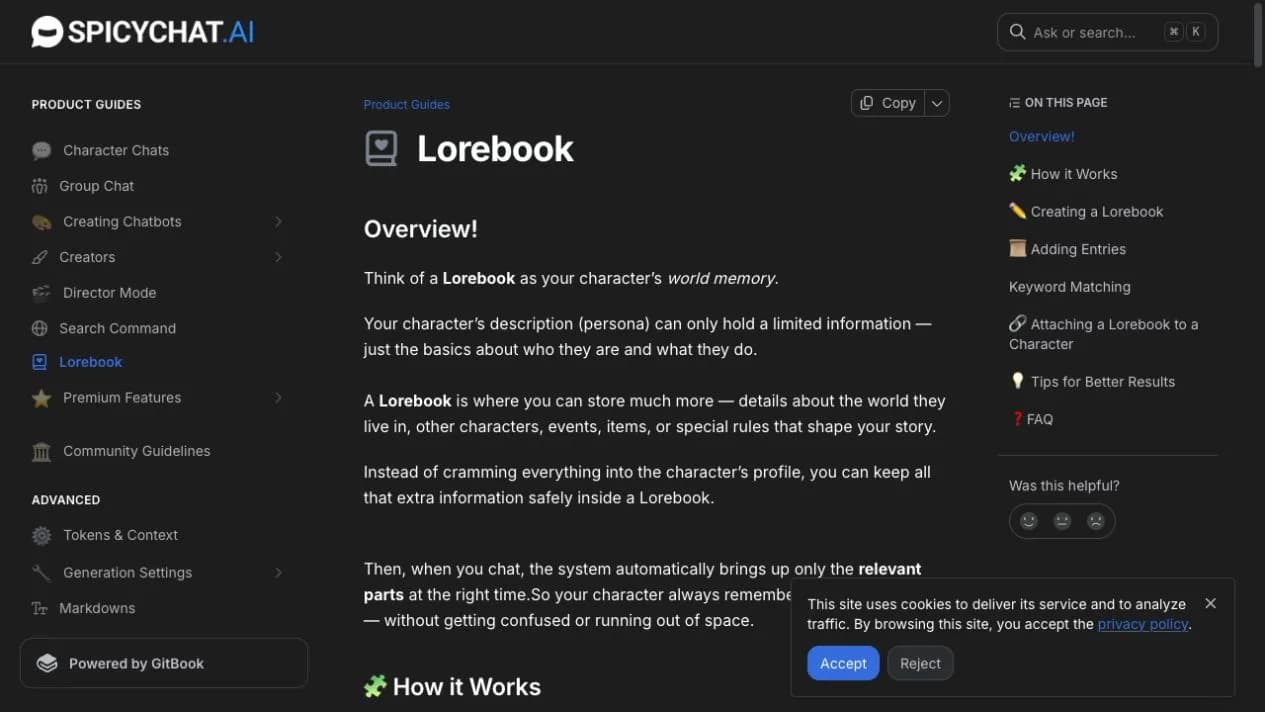 Complete official-page screenshot, checked July 21, 2026. Interface language and regional availability may vary.
SpicyChat is a hosted roleplay workspace with public characters, custom chatbots, Personas, Lorebooks, group chat, Director Mode, generation settings, multiple models, conversation images, and optional text-to-speech.
Its official token guide makes the context ladder unusually concrete: Free and Get a Taste reach 4,096 tokens, True Supporter 8,192, and I’m All In 16,384. Free and Get a Taste replies reach up to 180 tokens; the higher tiers reach up to 300.
Memory is layered rather than magical. Recent context, Semantic Memory 2.0, manually edited Memory Manager entries, and keyword-triggered Lorebooks solve different problems. A larger plan cannot rescue an overloaded character definition or contradictory lore.
 Complete official-page screenshot, checked July 21, 2026. Interface language and regional availability may vary.
Chub AI is an author-and-model-routing workspace. Its official guides expose character definitions, prompt order, Lorebooks, scan depth, token budgets, recursive scanning, generation settings, Mars, and external API connections.
Both products use Lorebooks, but Chub AI exposes a particularly technical workflow: keywords, secondary keywords, insertion order, priority, case rules, recursive scanning, scan depth, and token budget. SpicyChat combines Lorebooks with Semantic Memory and a simpler editable Memory Manager.
Chub AI has the higher ceiling for users who want portable cards, custom model routing, and exact prompt control. SpicyChat has the lower setup cost for users who still want Lorebooks and long context inside one hosted product.
| Dimension | SpicyChat | Chub AI | LumiChat |
|---|---|---|---|
| Product shape | Hosted roleplay workspace | Chub AI is an author-and-model-routing workspace. Its official guides expose character definitions, prompt order, Lorebooks, scan depth, token budgets, recursive scanning, generation settings, Mars, and external API connections. | Curated relationship platform |
| Start-up effort | Low to medium | Medium to high | Low |
| Memory | Context + Semantic Memory + manager + Lorebook | Both products use Lorebooks, but Chub AI exposes a particularly technical workflow: keywords, secondary keywords, insertion order, priority, case rules, recursive scanning, scan depth, and token budget. SpicyChat combines Lorebooks with Semantic Memory and a simpler editable Memory Manager. | Three-layer continuity |
| Media | Conversation images; top-tier TTS | Neither platform should be chosen primarily for polished live video calls. SpicyChat documents conversation images and top-tier text-to-speech. Chub AI’s strongest official surface is text generation through model connections; media depends more on the surrounding setup. | Image, voice and video in chat |
| Control | Cards, Lorebooks, generation settings | Chub AI has the higher ceiling for users who want portable cards, custom model routing, and exact prompt control. SpicyChat has the lower setup cost for users who still want Lorebooks and long context inside one hosted product. | Curated roles and progression |
| Best fit | Authors who want hosted controls | Users prioritizing Chub AI | Users prioritizing continuity |
SpicyChat’s cost is a single tiered subscription. Chub AI’s official API guide lists Mars at US$20 per month with unlimited messaging, while external OpenAI, Anthropic, OpenRouter, Google, or local routes can create separate usage or hardware costs.
 Complete official-page screenshot, checked July 21, 2026. Interface language and regional availability may vary.
Test the exact character, model, and paid tier you intend to keep. A homepage demo cannot predict a community card, a different model route, or a media wallet.
SpicyChat fixes available context by plan. Chub AI limits depend on the selected model route, provider quota, context size, lorebook token budget, scan depth, and prompt construction. “Unlimited messaging” on Mars does not mean infinite context.
A message-count headline is never the whole limit. Context, reply length, model access, queue, credits, voice, and media can interrupt different parts of the same week. Record the first restriction that changes your behavior.
Both products use Lorebooks, but Chub AI exposes a particularly technical workflow: keywords, secondary keywords, insertion order, priority, case rules, recursive scanning, scan depth, and token budget. SpicyChat combines Lorebooks with Semantic Memory and a simpler editable Memory Manager.
Memory is layered rather than magical. Recent context, Semantic Memory 2.0, manually edited Memory Manager entries, and keyword-triggered Lorebooks solve different problems. A larger plan cannot rescue an overloaded character definition or contradictory lore.
After turn 20, leave the chat and return later. Ask a natural question rather than a memory quiz. The winning product should resume the relationship and current scene with less manual explanation.
Neither platform should be chosen primarily for polished live video calls. SpicyChat documents conversation images and top-tier text-to-speech. Chub AI’s strongest official surface is text generation through model connections; media depends more on the surrounding setup.
Judge audio and media separately: listening is not the same as a live call, an image allowance is not unlimited generation, and a consistent portrait does not prove conversational memory.
Chub AI has the higher ceiling for users who want portable cards, custom model routing, and exact prompt control. SpicyChat has the lower setup cost for users who still want Lorebooks and long context inside one hosted product.
Use one safe adult-fiction prompt, then continue for 20 turns. Record persona drift, repetition, initiative, correction recovery, location recall, response latency, and the first paid boundary.
After turn 20, leave the chat and return later. Ask a natural question rather than a memory quiz. The winning product should resume the relationship and current scene with less manual explanation.
Test the exact character, model, and paid tier you intend to keep. A homepage demo cannot predict a community card, a different model route, or a media wallet.
| Scenario | Best choice | Why |
|---|---|---|
| You want transparent context tiers | SpicyChat | The token guide states plan-by-plan context |
| You want the rival’s core advantage | Chub AI | Chub AI has the higher ceiling for users who want portable cards, custom model routing, and exact prompt control. SpicyChat has the lower setup cost for users who still want Lorebooks and long context inside one hosted product. |
| You want a technical world-building workflow | Chub AI | Both products use Lorebooks, but Chub AI exposes a particularly technical workflow: keywords, secondary keywords, insertion order, priority, case rules, recursive scanning, scan depth, and token budget. SpicyChat combines Lorebooks with Semantic Memory and a simpler editable Memory Manager. |
| You want a low-setup companion | LumiChat | Chub AI is an author-and-model-routing workspace. Its official guides expose character definitions, prompt order, Lorebooks, scan depth, token budgets, recursive scanning, generation settings, Mars, and external API connections. |
| You want relationship levels and chapters | LumiChat | Curated roles connect to ongoing progress |
| You need six localized web routes | LumiChat | Discovery and reading stay in the selected locale |
| Test | Record |
|---|---|
| Turn 1 | Greeting quality, setup time, tone match |
| Turn 5 | Persona stability and repeated phrases |
| Turn 10 | Correction recovery and location |
| Turn 15 | Initiative and plot movement |
| Turn 20 | Active facts and context loss |
| Return session | Relationship, scene, and preference recall |
Use one safe adult-fiction prompt, then continue for 20 turns. Record persona drift, repetition, initiative, correction recovery, location recall, response latency, and the first paid boundary.
After turn 20, leave the chat and return later. Ask a natural question rather than a memory quiz. The winning product should resume the relationship and current scene with less manual explanation.
| Platform | Strength | Tradeoff |
|---|---|---|
| SpicyChat | Lorebooks, context tiers, memory controls, generation settings | Tiered context and authoring effort |
| Chub AI | Chub AI is an author-and-model-routing workspace. Its official guides expose character definitions, prompt order, Lorebooks, scan depth, token budgets, recursive scanning, generation settings, Mars, and external API connections. | SpicyChat fixes available context by plan. Chub AI limits depend on the selected model route, provider quota, context size, lorebook token budget, scan depth, and prompt construction. “Unlimited messaging” on Mars does not mean infinite context. |
| LumiChat | Curated multilingual roles, levels, chapters, in-chat media | Less low-level model control |
 Complete official-page screenshot, checked July 21, 2026. Interface language and regional availability may vary.
LumiChat is not trying to be the biggest public card archive or the most technical prompt laboratory. It connects curated multilingual characters, three-layer continuity, relationship levels, character story arcs, and image, voice, or video moments in one hosted path.
That makes LumiChat the practical third option when SpicyChat creates too much tuning work or the rival creates too much catalog, token, or subscription evaluation. Each article refreshes three character entry cards; video is shown first when a selected character has one.
| Dimension | Record | Why |
|---|---|---|
| Discovery | Three refreshed cards | Less catalog noise |
| Continuity | Three-layer memory structure | Less manual summary work |
| Progress | Relationship levels and chapters | Clearer long-term direction |
| Media | Video first when available | Media is tied to the role |
| Localization | Six web locales | Lower reading and setup friction |
| Decision | Same 20-turn test | Comparable evidence before payment |
Use one safe adult-fiction prompt, then continue for 20 turns. Record persona drift, repetition, initiative, correction recovery, location recall, response latency, and the first paid boundary.
After turn 20, leave the chat and return later. Ask a natural question rather than a memory quiz. The winning product should resume the relationship and current scene with less manual explanation.
Choose SpicyChat for a hosted all-in-one roleplay path with clear context tiers, Semantic Memory, Memory Manager, conversation images, and optional text-to-speech. Choose Chub AI for portable cards, keyword Lorebooks, prompt construction, and the freedom to use Mars or external model routes. Choose LumiChat when you want continuity and relationship progress without managing prompts or API connections.
Chub AI has the higher ceiling for users who want portable cards, custom model routing, and exact prompt control. SpicyChat has the lower setup cost for users who still want Lorebooks and long context inside one hosted product.
That makes LumiChat the practical third option when SpicyChat creates too much tuning work or the rival creates too much catalog, token, or subscription evaluation. Each article refreshes three character entry cards; video is shown first when a selected character has one.
Chub AI has the higher ceiling for users who want portable cards, custom model routing, and exact prompt control. SpicyChat has the lower setup cost for users who still want Lorebooks and long context inside one hosted product.
After turn 20, leave the chat and return later. Ask a natural question rather than a memory quiz. The winning product should resume the relationship and current scene with less manual explanation.
LumiChat is not trying to be the biggest public card archive or the most technical prompt laboratory. It connects curated multilingual characters, three-layer continuity, relationship levels, character story arcs, and image, voice, or video moments in one hosted path.
Use a separate password, review deletion and renewal controls, avoid putting real identifying details into fictional chats, and treat generated media as data that may be retained under the current policy.
For adult fictional roleplay, confirm age requirements, content boundaries, reporting tools, consent controls, and refund terms. “Unfiltered” never means a service has no rules or that every request is permitted.
Guide 1 · Guide 2 · Guide 3 · Guide 4
Evidence was checked on July 21, 2026 using official pricing, product, help, terms, token, memory, Lorebook, and API pages. The screenshots in this article are complete 16:9 captures of the visible official interfaces; lazy-loaded areas were checked before capture.
Scores are editorial heuristics, not laboratory benchmarks. They describe setup effort, clarity, continuity, media access, and control for the stated use case. Prices, model names, and feature availability should be verified again at checkout.
Choose SpicyChat for a hosted all-in-one roleplay path with clear context tiers, Semantic Memory, Memory Manager, conversation images, and optional text-to-speech. Choose Chub AI for portable cards, keyword Lorebooks, prompt construction, and the freedom to use Mars or external model routes. Choose LumiChat when you want continuity and relationship progress without managing prompts or API connections.
SpicyChat’s cost is a single tiered subscription. Chub AI’s official API guide lists Mars at US$20 per month with unlimited messaging, while external OpenAI, Anthropic, OpenRouter, Google, or local routes can create separate usage or hardware costs.
SpicyChat fixes available context by plan. Chub AI limits depend on the selected model route, provider quota, context size, lorebook token budget, scan depth, and prompt construction. “Unlimited messaging” on Mars does not mean infinite context.
Both products use Lorebooks, but Chub AI exposes a particularly technical workflow: keywords, secondary keywords, insertion order, priority, case rules, recursive scanning, scan depth, and token budget. SpicyChat combines Lorebooks with Semantic Memory and a simpler editable Memory Manager.
Neither platform should be chosen primarily for polished live video calls. SpicyChat documents conversation images and top-tier text-to-speech. Chub AI’s strongest official surface is text generation through model connections; media depends more on the surrounding setup.
Chub AI has the higher ceiling for users who want portable cards, custom model routing, and exact prompt control. SpicyChat has the lower setup cost for users who still want Lorebooks and long context inside one hosted product. After turn 20, leave the chat and return later. Ask a natural question rather than a memory quiz. The winning product should resume the relationship and current scene with less manual explanation.
LumiChat is not trying to be the biggest public card archive or the most technical prompt laboratory. It connects curated multilingual characters, three-layer continuity, relationship levels, character story arcs, and image, voice, or video moments in one hosted path.
Open LumiChat Discover, pick one of the three refreshed character cards, and run the same safe 20-turn scene before deciding which platform deserves a subscription.

Continue in LumiChat
Browse active characters, choose a personality that fits, and start chatting in seconds.
Role play chat guide
A hands-on role play chat workflow for choosing a character, opening a scene, testing continuity and deciding whether the experience is worth continuing.
AI chat alternatives
A neutral comparison of community-card workflows and LumiChat’s hosted browser route without claiming automatic migration.
AI character platform alternatives
Ten free and paid SpicyChat alternatives ranked by story control, memory, setup, model choice, media, and value.
AI companion memory guide
A privacy-aware scorecard for testing recall, corrections, deletion, and cross-session continuity with harmless facts.