

Osaka underground DJ
Takahashi Nozomi
A Techno DJ from Shinsaibashi with direct energy and a strong sense of rhythm, suited to music, nightlife, and lively chat.
Chat starten→AI chat platform field test
Compare seven AI tavern chat platforms for character cards, group roleplay, lore, memory, voice, video features, setup, privacy, and current limits.
13 min read
Quick answer
LumiChat is the simplest hosted tavern-style start; SillyTavern gives power users the deepest card, group, TTS, and model control, while Character.AI is easier for community discovery and two-way voice calls.
Schnellstart
Osaka underground DJ
A Techno DJ from Shinsaibashi with direct energy and a strong sense of rhythm, suited to music, nightlife, and lively chat.
Chat starten→

KI-Kreation
Bearbeite ein autorisiertes Erwachsenenfoto in der gewählten Intensität.
Tool öffnen→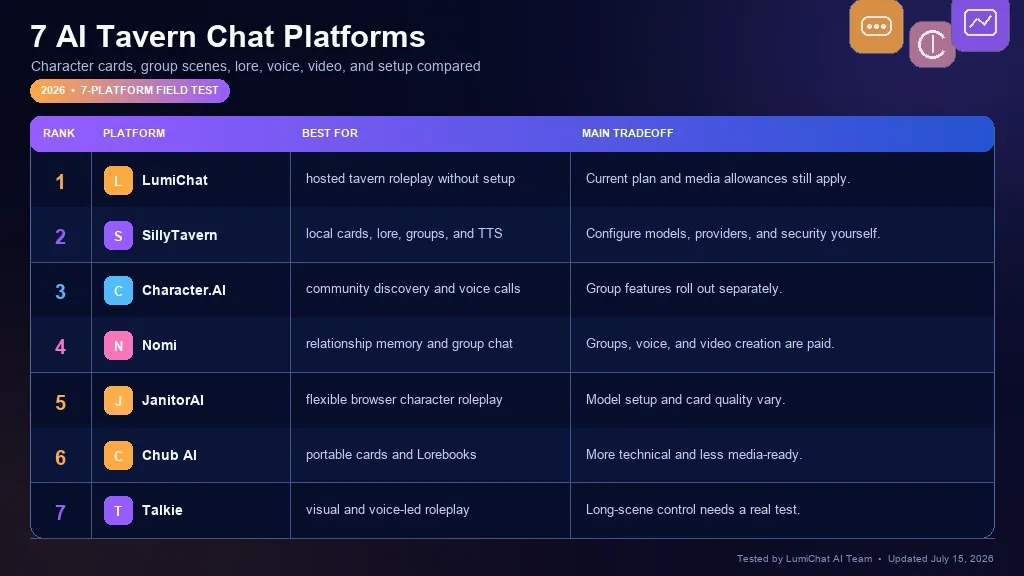
Platform comparison
The 7 best AI tavern chat platforms in 2026 serve two very different users. One wants to import cards, connect a model, tune lore, choose a speaker order, and wire up text-to-speech (TTS). The other wants the tavern feeling—distinct characters, group scenes, voice, and visual moments—without maintaining a local stack. Ranking them fairly requires separating configuration power from a ready-to-chat product.
LumiChat is the simplest hosted tavern-style start; SillyTavern gives power users the deepest card, group, TTS, and model control, while Character.AI is easier for community discovery and two-way voice calls.
| Rank | Platform | Best for | Main tradeoff |
|---|---|---|---|
| 1 | LumiChat | hosted tavern-style roleplay without setup | Check the current free allowance and whether a desired media action uses membership or credits. |
| 2 | SillyTavern | maximum local cards, groups, lore, and TTS | Users must configure models, providers, security, and often media extensions themselves. |
| 3 | Character.AI | community characters and two-way voice calls | Policies, phased features, and community quality can change the same scenario substantially. |
| 4 | Nomi | memory-led group relationships and voice | Group chat, voice, and video creation are paid capabilities rather than a complete free bundle. |
| 5 | JanitorAI | flexible community roleplay in a browser | Model setup, availability, and community-card quality need close attention. |
| 6 | Chub AI | portable cards, lorebooks, and model control | It is more technical and less media-ready than an all-in-one companion platform. |
| 7 | Talkie | visual and audio-first roleplay | Media presentation can look stronger than long-scene writing and memory. |
We created a safe tavern scene with three adult fictional characters, one shared location, a secret known by only one person, a conflict, a time jump, and a correction. We scored character separation, lore retention, group control, setup time, mobile access, voice type, video meaning, privacy, and cost clarity. Voice narration, two-way calls, generated video, video recognition, and live video calls were recorded as different capabilities.
LumiChat starts from curated character cards instead of a blank assistant. Six-language discovery, relationship continuity, and optional image, voice, video-clip, and chapter interactions make it easy to move from a quick scene into a recurring story. Group-style scenes can be written with distinct roles, while each normal conversation remains private to the account.
Main tradeoff: Check the current free allowance and whether a desired media action uses membership or credits.
SillyTavern is a locally installed power-user frontend, not a hosted model. It supports character cards, World Info, multi-bot group rooms, reply-order controls, image engines, speech recognition, and many TTS providers, giving it the deepest tavern-style configuration in this list.
Main tradeoff: Users must configure models, providers, security, and often media extensions themselves.
Character.AI has one of the broadest community libraries for anime, fandom, and original personas. Its current voice calls are two-way and available on web, while Character Voice is designed for one-to-one chats; multi-character group chat improvements have been rolling out separately, so availability should be checked on the user’s device.
Main tradeoff: Policies, phased features, and community quality can change the same scenario substantially.
Nomi focuses on persistent relationships, layered memory, custom backstory, multiple companions, and paid group chats. Voice messages and hands-free calls preserve the same conversation context, while video creation is a different feature from a live video call.
Main tradeoff: Group chat, voice, and video creation are paid capabilities rather than a complete free bundle.
JanitorAI combines a large community character catalogue with flexible roleplay and model-access choices. It resembles a browser tavern for users who value cards and narrative freedom, but voice and video are not the core turnkey experience.
Main tradeoff: Model setup, availability, and community-card quality need close attention.
Chub AI is built around portable character cards, lorebooks, model connections, and technical control. It rewards users who understand prompts and context budgeting and who want to move personas between compatible tools.
Main tradeoff: It is more technical and less media-ready than an all-in-one companion platform.
Talkie is visually led and lets creators shape appearance, voice, personality, and multimodal presentation. It works well when the character’s look and sound matter as much as prose, but “visual interaction” should not automatically be read as a live two-way video call.
Main tradeoff: Media presentation can look stronger than long-scene writing and memory.
The phrase “voice and video chat” is often imprecise. Text-to-speech (TTS) narrates a generated message; a voice message exchanges audio; a voice call is hands-free and two-way. Generated video creates a clip, and video recognition lets a model inspect camera input; neither automatically equals a live avatar video call. The table and reviews use those labels carefully so a media icon does not become an exaggerated promise.
Choose LumiChat for hosted character discovery and optional media without technical setup; SillyTavern for maximum local cards, lore, groups, TTS, and provider control; Character.AI for a large community and simple two-way calls; Nomi for relationship memory and paid group rooms; JanitorAI for flexible community roleplay; Chub AI for portable cards and lorebooks; and Talkie for visual and audio presentation.
Continue with: anime AI chat guide · AI girlfriend chat guide · tavern AI chat guide · AI voice character guide · privacy checklist
Local control is not automatically private if the connected model or TTS provider is remote. Hosted convenience is not automatically unsafe if deletion and account controls are clear. Audit every component that receives text, audio, images, or camera input, use fictional data, keep backups of cards you own, and never upload another person’s voice or face without permission.
It is a character-roleplay environment built around personas, cards, lore, scenes, and often several model or media controls.
LumiChat is the simplest hosted start in this comparison; SillyTavern offers more control but requires setup.
SillyTavern and Nomi provide explicit multi-character rooms; availability and plan rules differ elsewhere.
Many do, but the mode may be TTS, voice messages, or a two-way call. Check the exact label.
Some offer generated video or video recognition instead. Do not assume either is a live two-way avatar call.
The interface can run locally, but privacy also depends on the model, image, speech, and TTS providers you connect.
Start with the same three-character tavern scene on one hosted platform and one configurable platform. Measure setup minutes, persona mixing, recall after a time jump, voice latency, what the video button really does, and the total cost before choosing.

Weiter in LumiChat
Sieh dir aktive Charaktere an, wähle eine Persönlichkeit, die passt, und starte in Sekunden ein Gespräch.
Tavern AI chat guide
Choose between configurable Tavern-style character cards and a managed browser-based character chat route.
AI roleplay platform ranking
Ten free-to-start AI roleplay chatbots ranked by a repeatable scene test, with a clear best use and tradeoff for every platform.
AI roleplay chatbot comparison
A practical comparison of seven AI roleplay chatbots, tested for character clarity, continuity, scene control, setup, privacy, and trial value.
AI voice guide
AI voice character adds a new layer to character chat — hearing the AI speak in a consistent tone changes the feel of roleplay and companion sessions. This guide explains how it works.